Diamond Discs: Ethnic series
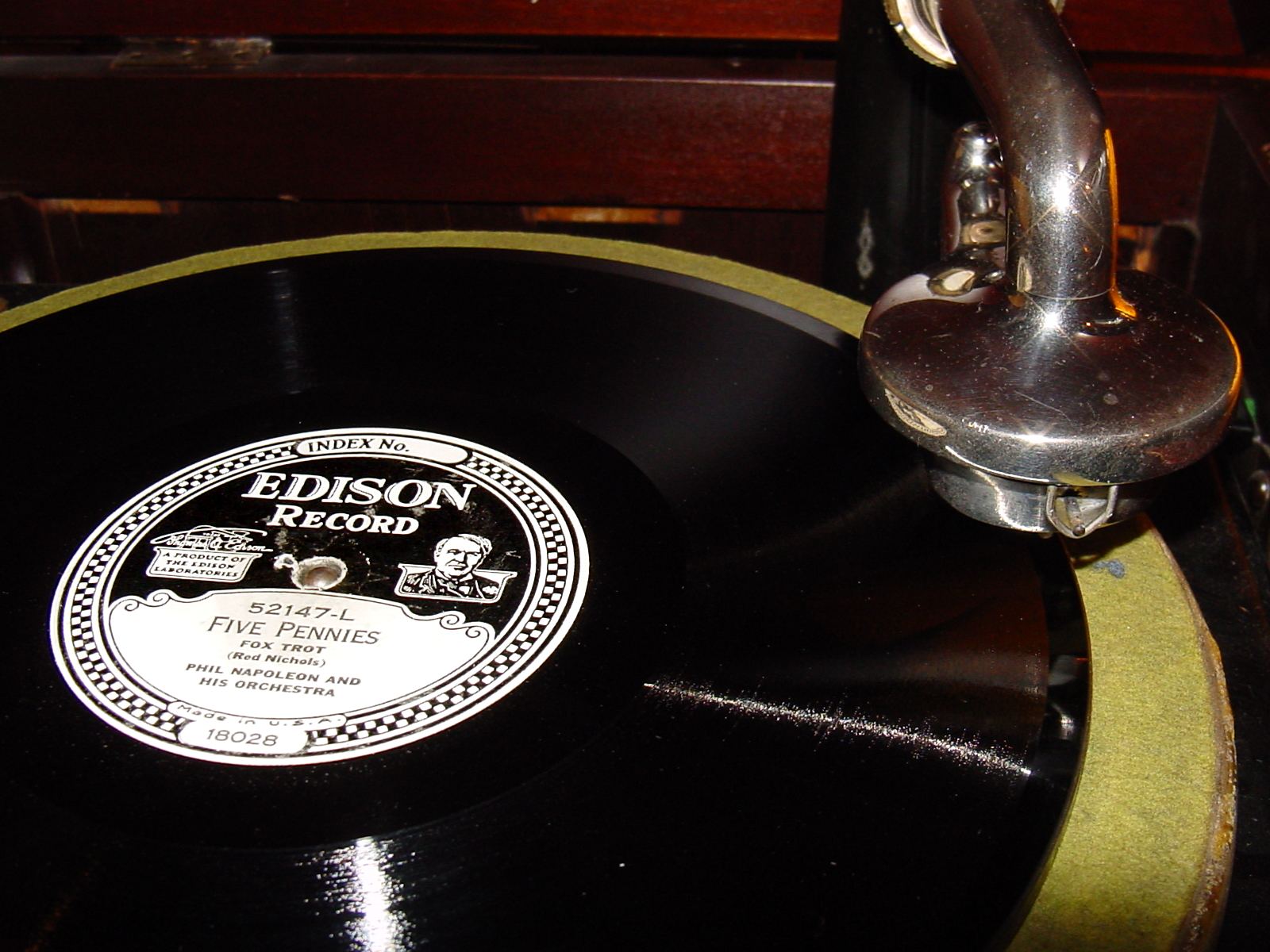
Image credit: Wikimedia Commons (Norman Bruderhofer "DiamondDiscPhonograph.jpg" / CC BY-SA 2.5)
The Diamond Discs: Ethnic series was a subseries of the Edison Diamond Discs that primarily bundled recordings of foreign languages and ethnicities (including those for immigrant communities). In the company's catalogs from the late 1920s, a multi-language section called "Foreign Language and Ethnic" was created, and foreign language recordings were presented as a uniform group.
In the discography materials (DAHR/UCSB), the Ethnic series is treated independently as an "Issue Series" of the Edison label's Diamond Discs, with sub-groups by language (cultural area) and corresponding number ranges listed side by side. This structure shows that the series can be organized along a verifiable axis of "language (cultural area) x number range."
- https://www.loc.gov/collections/edison-company-motion-pictures-and-sound-recordings/articles-and-essays/history-of-edison-sound-recordings/history-of-the-edison-disc-phonograph/
- https://www.loc.gov/collections/edison-company-motion-pictures-and-sound-recordings/articles-and-essays/history-of-edison-sound-recordings/overview-of-the-diamond-disc-recordings/
- https://adp.library.ucsb.edu/index.php/objects/index?Objects%5BLabelName%5D=Edison&Objects_sort=Audio
Series Overview
This series treats the "foreign language and ethnic (immigrant)" recordings included on Edison's Diamond Disc (1912–1929) as a series (or equivalent classification unit). In terms of catalog divisions, the company's 1928 record catalog includes sections such as "Foreign Language and Ethnic," "German," "French," "Italian," "Spanish," "Scandinavian," "Russian," "Hebrew/Yiddish," "Bohemian," and "Polish." Furthermore, Diamond Disc catalogs from the 1920s reportedly organized foreign language recordings into at least 16 ethnic series. These divisions suggest that repertoires reproduced by cultural sphere (e.g., dance music, folk songs, stage songs, religious/festival music, and popular songs) were treated as units of sales and distribution, rather than simply linguistic differences.
The company also had international bases (overseas offices), but Diamond Disc was more of a set consisting of the machine and disc, and compared to its main series for English-speaking countries, the scale of supply to the foreign language and immigrant markets was relatively limited (this is an important point to consider when comparing with other companies of the same era).
- https://www.loc.gov/collections/edison-company-motion-pictures-and-sound-recordings/articles-and-essays/history-of-edison-sound-recordings/overview-of-the-diamond-disc-recordings/
- https://adp.library.ucsb.edu/index.php/objects/index?Objects%5BLabelName%5D=Edison&Objects_sort=Audio
Series Features
Diamond Discs: The Ethnic series had the same media specifications as the Diamond Disc series, with hill-and-dale cut grooves, approximately 80 rpm, and a 10-inch disc length of approximately 5 minutes per side. Playback was intended to be on a dedicated machine (with a diamond stylus), and playback on lateral vibration machines was not anticipated.
In terms of the numbering system, the Ethnic series is often designated by a number band corresponding to a grouping by language (cultural area), and multiple number bands can coexist within the same language area. Even when browsing the Edison labels of the DAHR (UCSB), you can see examples where the same language appears again in a different number band. This shows that the number assignment can vary depending on the chapter structure (organization by language) in the catalog and on conditions such as size and time period.
- https://www.loc.gov/collections/edison-company-motion-pictures-and-sound-recordings/articles-and-essays/history-of-edison-sound-recordings/history-of-the-edison-disc-phonograph/
- https://adp.library.ucsb.edu/index.php/objects/index?Objects%5BLabelName%5D=Edison&Objects_sort=Audio
Board notation and identification points

Image credit: Wikimedia Commons (National Park Service "Record label of "Sinking of the Titanic" ... 51823-R.jpg" / Public domain)
Diamond discs were designated with an L (left) or R (right) designation on each side, with each side of the same number being managed as a pair. In addition to the record number (issue number), the disc surface sometimes also carries a matrix number (a management number for the starting point of recording), making it easy to track the edition and lineage from the disc itself.
The label's formatting also changed over time. In the early days, the policy was not to include the artist's name on the label, but in later years the artist's name was added. Furthermore, in the 1920s, changes to the label's appearance also occurred, such as the introduction of paper labels.
The Ethnic series has an organizational axis called "number ranges by language (cultural area)" superimposed on top of these common specifications, so by matching the language name, number range, label notation, and matrix information, it is possible to identify songs with the same name or from the same series without confusing them.
- https://www.loc.gov/collections/edison-company-motion-pictures-and-sound-recordings/articles-and-essays/history-of-edison-sound-recordings/history-of-the-edison-disc-phonograph/
- https://commons.wikimedia.org/wiki/File:Record_label_of_%22Sinking_of_the_Titanic%22_by_Ernest_Stoneman,_Edison_Diamond_Disc_51823-R.jpg
- https://upload.wikimedia.org/wikipedia/commons/0/0b/Record_label_of_%22Sinking_of_the_Titanic%22_by_Ernest_Stoneman%2C_Edison_Diamond_Disc_51823-R.jpg
Language division and number range
On the browse screen for Edison labels at the "Discography of American Historical Recordings" website run by the University of California, Santa Barbara, "Diamond Discs: Ethnic series" is displayed as the Issue Series, and furthermore, groups by language (cultural area) are presented as Issue Sub-Series with number ranges (the number of items displayed is the number on the same screen, as of January 2026).
- Spanish and Cuban (60000; 76000 series) (100)
- German (57000; 73000 series) (47)
- French (58000; 74000 series) (44)
- Scandinavian (59000; 78000 series) (37)
- Hebrew/Yiddish (59500; 75000 series) (22)
- Bohemian (65000 series) (26)
- Polish (65300 series) (23)
- Russian (65500 series) (11)
- Finnish (59300 series) (8)
- Italian (64000 series) (2)
Also, on this screen, in addition to the language groupings, there are smaller number blocks.
- 22560–22595 (Cuban) (35)
- 26001–26215 (German) (14)
- 27001–27219 (French) (37)
- 90000 series (Spanish; 10-in.) (4)
This shows that multiple number ranges can coexist even within the same language area. When organizing the ethnic series, this fact that "language names can be distributed across multiple number ranges" is important from the perspective of catalog history and operational history.
Content trends
The Ethnic series focuses on foreign language albums, targeting both the demand of immigrant communities in the United States and distribution to overseas markets. Number ranges are assigned by language (cultural area), allowing for both continuous catalog development within the same language and distinctions between languages.
These examples show that the Ethnic series was not simply a collection of "the same songs translated," but rather a collection of repertoire unique to each cultural sphere (including vocal, instrumental, dance, and dramatic elements) organized by language as a product. However, because the genre composition and ratios can vary depending on the year of the catalog, sales region, and year of recording, biases in representative repertoire, main performers, and recording locations for each language block must be verified based on primary sources.
Recording and production background
Foreign and ethnic recordings were divided into multiple languages in the company's catalogs, with catalogs from the late 1920s featuring sections for Czech, French, German, Italian, Polish, Russian, and Spanish. Because Edison maintained offices overseas, these recordings could have a dual purpose: for sale overseas and to immigrant communities in the United States.
On the other hand, it is said that other companies, such as Victrola (Victor), built larger catalogs of similar foreign language recordings. The LOC's explanation suggests that the high cost of Edison's phonographs may have been one reason why the number of foreign language recordings did not increase as much as that of its competitors. It also points out that the number of records in this category that remain is limited, and that there are not many examples in the LOC collection.
- https://www.loc.gov/collections/edison-company-motion-pictures-and-sound-recordings/articles-and-essays/history-of-edison-sound-recordings/overview-of-the-diamond-disc-recordings/
- https://www.loc.gov/collections/edison-company-motion-pictures-and-sound-recordings/articles-and-essays/history-of-edison-sound-recordings/history-of-the-edison-disc-phonograph/
Major primary sources and archives

Image credit: Wikimedia Commons (National Park Service "EDIS-40494_DD-52044-mx-11734.jpg" / Public domain)
The core resources for tracing the Ethnic Series from a primary source perspective are the DAHR (UCSB) Discography Browse, the Thomas Edison National Historical Park (NPS)'s commentary and numbering examples (including disc surface photographs), and the Library of Congress's Diamond Disc overview. The DAHR provides an overview of language classifications and numbering ranges in the "Issue Series/Issue Sub Series" hierarchy, the NPS provides examples of language names and corresponding numbers, and the LOC provides an overview of media specifications and the positioning of foreign language and ethnic recordings in relation to catalog classifications and market conditions. In addition, the UCSB Library's introduction explains the background to the large-scale digitization and public release of Edison recordings, including those held at the park.
- https://www.loc.gov/collections/edison-company-motion-pictures-and-sound-recordings/articles-and-essays/history-of-edison-sound-recordings/overview-of-the-diamond-disc-recordings/
- https://adp.library.ucsb.edu/index.php/objects/index?Objects%5BLabelName%5D=Edison&Objects_sort=Audio
- https://www.nps.gov/edis/learn/historyculture/music-of-foreign-countries.htm
- https://commons.wikimedia.org/wiki/File:EDIS-40494_DD-52044-mx-11734.jpg
- https://www.library.ucsb.edu/news/thousands-edison-sound-recordings-now-digitized-available-online
Terminology and classification notes
“"Ethnic" was a classification term used in catalogues at the time, and does not necessarily reflect modern academic classifications or the self-designations of those involved. Therefore, in explaining this series, it is important to organise the information based on the indications in primary sources (language name, number range, catalogue classification) and clearly state the position of the word as used historically.
For this reason, when explaining this series, it is important to organize the information based on the names in the primary sources (language name, number range, and catalog category) and clearly indicate the historical usage of the words. Additionally, by listing the correspondence between language names (German, French, Spanish, etc.) and number ranges, the chapter divisions in the catalog, and the series designation in the discography, the basis for classification can be traced.
- https://www.loc.gov/collections/edison-company-motion-pictures-and-sound-recordings/articles-and-essays/history-of-edison-sound-recordings/overview-of-the-diamond-disc-recordings/
- https://adp.library.ucsb.edu/index.php/objects/index?Objects%5BLabelName%5D=Edison&Objects_sort=Audio
The historical significance of the series
The significance of the Diamond Discs: Ethnic series lies in the fact that it systematized foreign language and ethnic recordings by language (cultural sphere) within the unique Diamond Disc format. The existence of a foreign language section in the catalog from the late 1920s indicates that the company was treating foreign language recordings as a separate category, at least in terms of sales.
Furthermore, because the series is organized around "language (cultural sphere)" rather than "musical genre," it can also be read as a resource for immigration history, urban history (particularly recording activity in the New York area), and market history, including overseas distribution. Given the possibility that the volume was limited compared to competitors' foreign-language recordings and the scarcity of existing materials, this is an area that requires cross-reviewing both the actual items and the discography.
The "language name," "number range," "record surface notation," and "matrix information" in a discography are key to ensuring consistency in an area where there is a possibility of dispersion, re-editing, or re-recording. By organizing the series by "language name + number range" and presenting each recording's label notation (L/R, release number, matrix number), it becomes easier to use the data across the fields of music history, immigration history, and regional history.
- https://www.loc.gov/collections/edison-company-motion-pictures-and-sound-recordings/articles-and-essays/history-of-edison-sound-recordings/overview-of-the-diamond-disc-recordings/
- https://www.library.ucsb.edu/news/thousands-edison-sound-recordings-now-digitized-available-online
- https://adp.library.ucsb.edu/index.php/objects/index?Objects%5BLabelName%5D=Edison&Objects_sort=Audio