Edison Concert Records (“B” Series)

Image source: Wikimedia Commons (Public domain)
The Edison Concert Records ("B" Series) is a sub-series of the Edison "Cylinder: 2-minute Series," a sales line of concert cylinder records (approximately 5 inches in diameter) designed for louder volume reproduction, organized primarily by catalog numbers beginning with "B." In an era before electrical amplification, these records were positioned as a "high-output option" for mechanical playback to deliver sound to larger spaces.
The catalogue's operation can be divided into three stages: (1) when records were supplied in concert format with the same number as the standard title but with a "C" added, (2) when records were codified as number ranges with a "B" prefix after 1899, and (3) when records were specially ordered with a "C" added to the standard two-minute catalogue number after the final Concert Record catalogue in March 1901. At the special order stage, records were subject to different distribution conditions than regular shelf products, such as non-returnability.
- https://adp-assets.library.ucsb.edu/edison_2m-cyls.pdf
- https://commons.wikimedia.org/wiki/File:The_Edison_concert_phonograph_Have_you_heard_it%3F_LCCN99472463.jpg
Series Overview

Image source: Wikimedia Commons (Public domain)
Concert cylinders are larger in diameter than standard cylinders and were designed to be played on a dedicated machine (Edison Concert Phonograph) and compatible parts. The key point here is not "extending the playing time," but rather the fact that the design allows for a playback time of approximately 2 minutes, just like the standard model, while increasing the volume by expanding the recording surface (cylinder diameter).
The organization of the catalogue can be broadly divided into two stages. From 1899 onwards, they were systematised as number ranges prefixed with "B", but the "B" series came to an end with the final Concert Record catalogue in March 1901. After that, a system was introduced whereby any title in the standard two-minute catalogue could be custom ordered in concert format (standard number + C), and this practice is said to have continued into the Gold Moulded period.
- https://adp-assets.library.ucsb.edu/edison_2m-cyls.pdf
- https://commons.wikimedia.org/wiki/File:Brown_wax_cylinder,_NPS_catalog_number_EDIS_93947._(Credit-_National_Park_Service)_(8cea3ebe-155d-451f-676a-8db9ca2398ae).jpg
Series Features
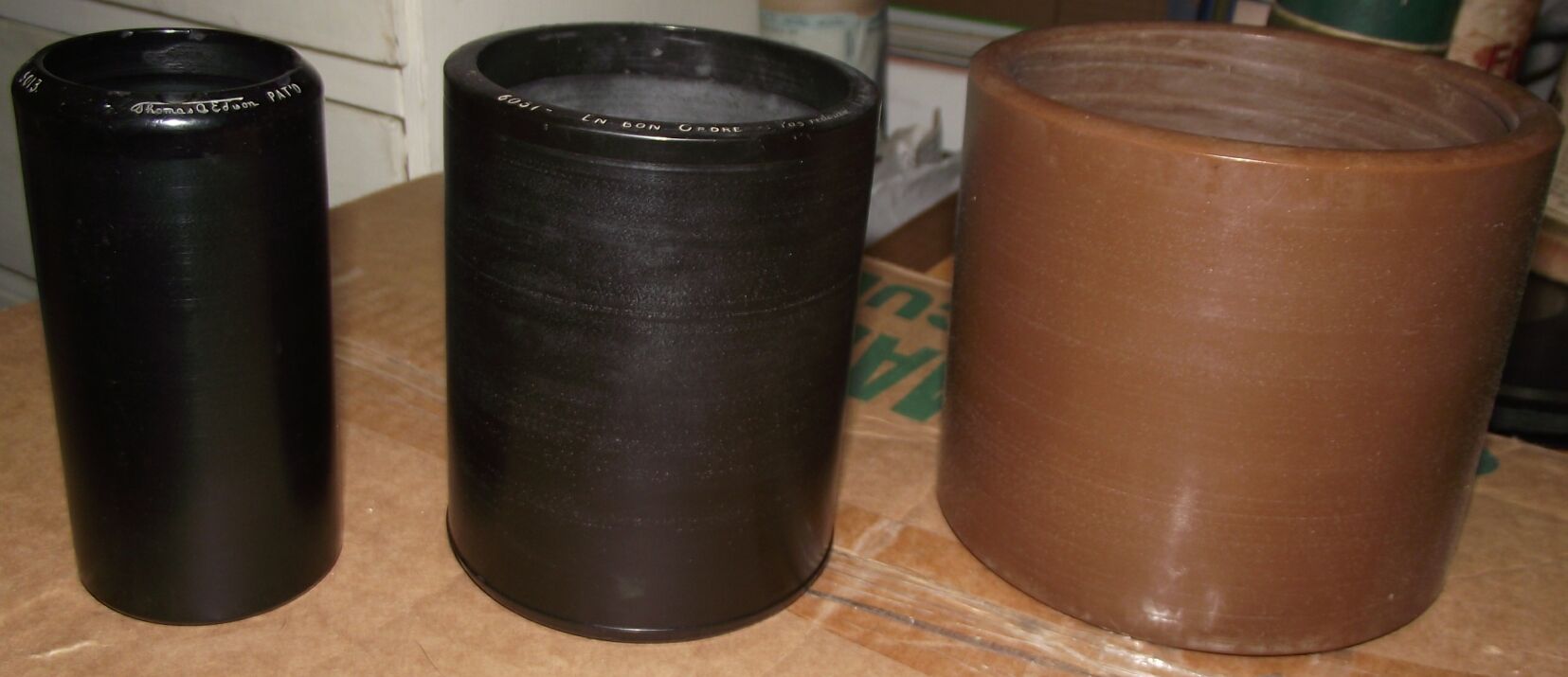
Image credit: Wikimedia Commons (CC0 1.0)
Its greatest feature is the increased volume (listening distance and space-filling power) achieved by its larger diameter. With mechanical playback, sound is emitted into space using a combination of a needle, diaphragm, and horn, so a design with a larger recording surface was rational for playing in a wide area.
On the other hand, larger diameters also come with disadvantages, such as the need for specialized machines and parts, difficulty in storage and handling, and reduced efficiency in mass production and distribution. As a result, it is difficult for concert-use cables to become a permanent staple product, and as improvements in the standard cable (durability, supply capacity, price, etc.) progress, the standard cable will come to be seen as sufficient for home use, and demand will shrink.
- https://adp-assets.library.ucsb.edu/edison_2m-cyls.pdf
- https://commons.wikimedia.org/wiki/File:Cylindersdiameter.JPG
Numbering system and catalog operation (C added – B Series – Custom C)
Initially, for concerts, the standard catalog number was given a "C" so that the same title could be supplied in concert format. In other words, the program line was based on the standard version, and only the supply format was changed to the large-diameter version.
From 1899 onwards, concert recordings were organised into a number range prefixed with "B". However, the "B" series did not last long, and the final Concert Record catalogue was published in March 1901, after which the "B" series was discontinued. As an alternative, a system was introduced whereby any title in the standard two-minute catalogue could be ordered in concert format, with instructions given for adding a "C" to the standard number when ordering. Special-order items were generally non-returnable and were treated separately from regular shelf items. Furthermore, these special orders had exception conditions, such as "excluding Grand Opera recordings".
Manufacturing process (pantograph replication and electroforming)
The supply of concert masters was closely linked to the process of duplicating standard recordings onto larger diameter discs (pantograph duplication). According to sources, electroplating of concert pantograph masters began on May 23, 1899, and production slowed sharply after August 1900, with the last electroplated concert master being dated January 31, 1901.
It also shows that companies did not actively mass-produce molded products for concert use. As molded records became more widespread in the standard range and durability, price, and supply stability improved, the standard range for home use became more likely to be considered "sufficient volume," and the significance of concert-use products weakened in comparison. This shows that manufacturing policy was influenced not only by the feasibility of the technology but also by the "end point desired by the market."
Related equipment (Edison Concert Phonograph and conversion kit)
Concert cylinders were deployed in conjunction with a specialized (or highly optimized) playback environment called the Edison Concert Phonograph, which was first advertised in February 1899 and whose price was reduced from $4 to $2.50 on November 1 of that year.
As improvements continued to be made to the standard, the dedicated nature of concert machines became a relative disadvantage. In March 1904, conversion kits were made available to convert concert-size machines to play standard cylinders, and the reduction of dedicated concert environments became a concrete reality. Furthermore, concert machines were removed from the domestic catalog in July 1907, and the option to order concert records was not mentioned until the September 1907 issue, but catalogs up to 1910 still contained mention of the availability of records and blanks.
Price and Distribution
Concert records were more of a conditionally supplied option than a mainstay on mass-market shelves. According to sources, concert records were offered for $4 each in early 1899, then reduced to $2.50 on November 1, 1899. The price continued to fall even after the introduction of Gold Molded records, reaching 75 cents ($9 a dozen) in July 1904. With the introduction of special orders from March 1901, distribution conditions that differed from those for regular products were clarified, such as special orders being non-returnable.
Sales were also limited, with Concert shipments totaling just over 5% between March 1899 and February 1902. Comparing the quantities for the same period, Concert shipments were 315,265 units, compared to approximately 5.95 million standard cylinders, indicating that Concerts were positioned on the periphery.
Recorded repertoire trends
Rather than having a large number of original recordings, the concert versions were more of a reproduction of "selected titles" from a standard catalogue in concert format. Therefore, the core of the repertoire was the standard line, and the concert versions should be understood as "another format for playing the same title at a louder volume."
Furthermore, special orders made after March 1, 1901, included exceptions such as "excluding Grand Opera recordings." This suggests that certain genres may have been difficult to match with the supply conditions for concert recordings (duplication, contracts, editing, sales design, etc.), but additional primary sources are needed to identify the decisive factors.
The historical significance of the series
The significance of Edison Concert Records ("B" Series) lies in the fact that they attempted to achieve "louder volume" as a commercial product using mechanical playback before electrical amplification. The large diameter of approximately 5 inches was designed for use in demonstrations, exhibitions, and playback in large spaces, and they are positioned as a concrete example of the establishment of a "high-output option" separate from the standard for home use.
On the other hand, concert sizes, which had been systematized as a number range prefixed with "B" since 1899, came to an end as the "B" series with the final Concert Record catalog in March 1901, and the subsequent shift to a system of special-order sizes with a "C" added to the standard number, shows that dedicated standards are unlikely to become established as a permanent staple. The company explained that once the standard size was improved in the molding process and approached practical levels in terms of volume, demand for concert sizes fell sharply; it can be concluded that the superiority of dedicated standards became relative once the improvements in the standard specifications reached the level required by the market.
Furthermore, while the last mention of ordering options was in September 1907, wording indicating their availability appears to have remained in catalogs up until 1910, suggesting that operational practices and catalog descriptions were not always updated simultaneously. From an institutional history perspective, distinguishing between the "B" series (systematized as a number range) and the custom-ordered Concert (supplied and operated using a standard number + C) allows for a consistent reading of document descriptions, including time differences.