40000 series

Image source: Wikimedia Commons (Public domain)
The 40000 series is the number range of the Amberol Grand Opera Records ($2.00 series), which was a top-priced range of opera/vocal music among Edison's quarter-minute wax cylinders, Amberol. Cataloged as the 40000 series (40000–40044), these records primarily featured arias, opera songs, and vocal music by top European singers.
This numbering range was established around 1910 as part of a reorganization of what were originally released as "B" numbers (e.g., B150) in the "Amberol Concert and Grand Opera Series" into new blocks based on price range. While Amberol as a whole symbolizes the transition from a "2-minute playback environment" to "4-minute playback," the 40000 series is one of the clearest divisions within that series, designed to specifically sell high-priced, high-end repertoire.
- https://adp-assets.library.ucsb.edu/edison_4m-cyls.pdf
- https://commons.wikimedia.org/wiki/File:Leo_Slezak_1909.jpg
Series Overview

Image source: Wikimedia Commons (Public domain)
The 40000 series (40000–40044) is the top-price range ($2.00) of Amberol (4-minute wax) Grand Opera series. Catalog listings are concentrated between May 1910 and April 1911, indicating that the shelves were produced intensively in a short period of time.
The recordings tend to feature singers singing solo (usually with orchestral accompaniment, though there are some later examples with piano accompaniment) and primarily feature pieces derived from famous opera arias and scenes. Specific examples include famous tenors of the time, such as Leo Slezak (1873–1946) and Karl Jörn (1873–1947), appearing early on, and the same famous pieces being performed multiple times by different singers, suggesting a design that combines the strength of the pieces with the singer's caliber to create a successful album.
- https://adp-assets.library.ucsb.edu/edison_4m-cyls.pdf
- https://commons.wikimedia.org/wiki/File:Edison_Amberol.jpg
Series Features

Image source: Wikimedia Commons (Public domain)
The 40000 series is characterized by its high-priced line of repertoire that maximizes the vocal highlights, based on the characteristics of the Amberol medium (4 minutes, high-density grooves). Opera arias have a clear climax in their structure, making them easy to create memorable moments even in short periods, making them well-suited to the home music media of the time.
The series also clearly embraced the "international vocal market." Recording locations include credits for Paris and London, and singers and recording opportunities secured in Europe were incorporated into Edison's U.S. catalog, creating a premium shelf. As a result, the series leaned more toward "buying specific singers" and "buying specific works" than the general Amberol series of the same period, with the number range itself functioning as a label for the "premium vocal shelf."
- https://adp-assets.library.ucsb.edu/edison_4m-cyls.pdf
- https://commons.wikimedia.org/wiki/File:Amberola75.jpg
The historical significance of the series
The historical significance of the 40000 series lies in the fact that it concretely represents the top tier of the "hierarchical catalog shelf" that Edison's cylinder business developed alongside disc manufacturers. Following the $0.75 (28000), $1.00 (30000), and $1.50 (35000), the $2.00 (40000) series justifies price differences within the same format based on the recording genre (especially Grand Opera) and the status of the singer.
At the same time, the 40000 series marks the culmination of the maturity of quarter-length wax Amberol (since its introduction in 1908), while also continuing the transition to Blue Amberol (quarter-length cylinders with a celluloid outer layer) that came into full swing later. Some songs were later re-recorded, re-arranged (or ported) to Blue Amberol, making the 40000 series a key point in tracing how the high-end reputation established by wax Amberol was connected to the next generation of media.
Numbering system and price range
The 40000 series is not simply a sequential number, but rather has a strong meaning as a "price range block." Amberol Concert/Grand Opera series were initially operated with numbers prefixed with "B," but around 1910, they were reorganized into new number ranges based on price, and price differences were made clear even within the same Grand Opera series. Specifically, the 28000 series ($0.75), 30000 series ($1.00), 35000 series ($1.50), and 40000 series ($2.00) are arranged in this order, creating "steps" within the same format.
This method is directly linked to catalog visibility (shelf arrangement) and ease of handling on the distribution side (explaining and displaying by price range). Because the number itself signals the price range, even purchasers who are unfamiliar with the title can understand that "numbers in the 40,000 range = top-tier opera shelves," which contributes to the organization of sales lines.
Recording location and production system
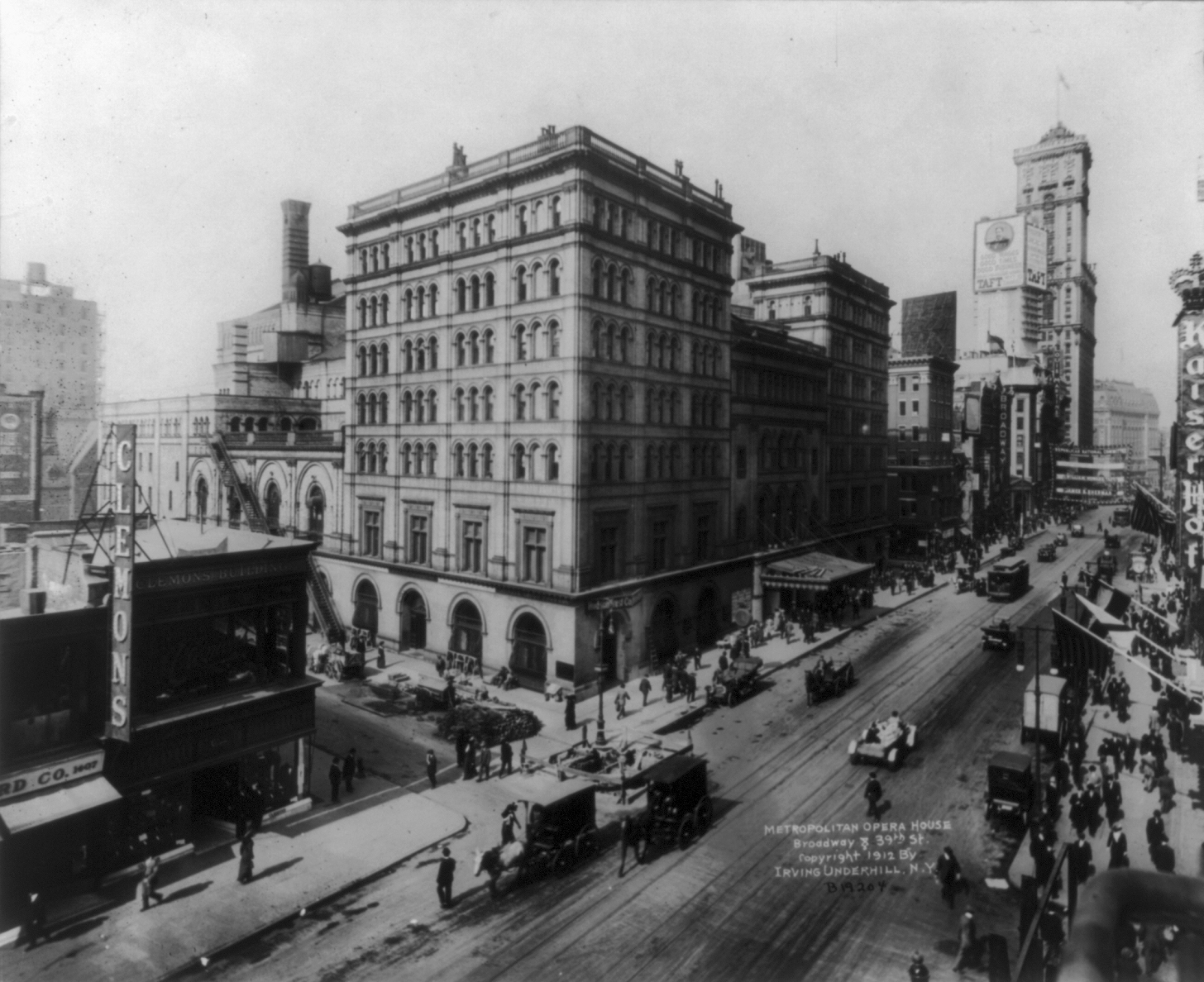
Image source: Wikimedia Commons (Public domain)
The 40,000 series' entries are dominated by Paris recordings, but also include entries for London and New York recordings. This suggests that rather than being a production completed at the US headquarters, the company operated by connecting with European singers and theater culture to secure recording opportunities and incorporate them into the US catalog. The lineup also included many leading European singers, making it a well-suited shelf for contemporary opera reception (including among immigrant communities).
Furthermore, while the accompaniment notations are primarily for orchestras, examples of piano accompaniment appear towards the end of the series, indicating that the scope of the series could extend beyond "grand theatrical arias" to vocal music in general. In other words, while the 40000 series bore the label "Grand Opera," in practice it also had an aspect of being flexibly used as a "high-end vocal repertoire."
- https://adp-assets.library.ucsb.edu/edison_4m-cyls.pdf
- https://commons.wikimedia.org/wiki/File:Metropolitan_Opera_House_1912_cph.3b11690.jpg
Relationship with subsequent series

Image source: Wikimedia Commons (Public domain)
The 40000 series was the top shelf of wax Amberol, but as Edison later shifted its focus to Blue Amberol (a quarter-minute cylinder with a celluloid outer layer), the track assets were transferred to the next medium. Some individual items in the 40000 series have notes indicating re-recordings or rearrangements to the Blue Amberol number, demonstrating the transition of the premium repertoire from the wax era to the "next-generation, durable medium."
In terms of media durability and product lifespan, the narrow-groove wax Amberol was at high risk of wear, so it made sense to transfer the same repertoire to the more durable Blue Amberol. As a result, the 40000 series not only completes the "luxury shelf of wax Amberol," but also serves as the foundation for the high-end vocal catalog from the Blue Amberol era.
- https://adp-assets.library.ucsb.edu/edison_4m-cyls.pdf
- https://commons.wikimedia.org/wiki/File:Making_blue_amberol_cylinder_records_in_Building_24,_%22this_machinery_went_through_the_fire.%22_(cbe8aacf-454f-4540-a5fd-9e3778aff15c).jpg
Actual state of catalog operation
The 40000 series is a number range that includes examples where the catalog listing month (Listed) does not match the actual recording date or production order. In the UCSB discography, 40000 (Listed: May 1910) is recorded as a re-presentation of Amb B150 (Paris), and it can be seen that existing recording assets were reclassified into the 40000 series as part of a price range reorganization around 1910.
Furthermore, the listings are not necessarily arranged in numerical order. For example, 40023–40026 were listed in July 1910, while the younger numbers 40018–40022 were listed in August 1910. Even at the end of the list, 40044 (March 1911) was listed before 40043 (April 1911), demonstrating a discrepancy between the numerical order and the listing order. Furthermore, 40043–40044 are listed as piano accompaniments, and the outer edge of the original central shelf for orchestral accompaniments is visible, indicating that this number range cannot be explained simply by sequential numbering.
Related Topics
Within Amberol (4-minute wax), the 40000 series is a number range organized as the top price range for Grand Opera (2.00 per TP for 4 liters). At the same time, other price range blocks also existed, such as the 28000 series (0.75 per TP for 4 liters), the 30000 series (1.00 per TP for 4 liters), and the 35000 series (1.50 per TP for 4 liters), which were designed to create price tiers within the same format. The 40000 series is unique in that it is the top tier and clearly separates high-end vocal repertoire into price and number ranges.
Furthermore, UCSB's discography includes examples where individual items are noted to correspond to Blue Amberol numbers, providing clues for tracing the path that connected the high-end vocal music shelves of the Wax Amberol era to the subsequent Blue Amberol era. The 40000 series not only shows the pricing system within Amberol, but also serves as a starting point for understanding the process by which song assets were passed down to later media and series.