Music recorded in March 1890
March 1890 was a month in which infrastructure and higher education expanded simultaneously, with the opening of the Forth Bridge in Scotland, completing the East Coast Railway route between London and Aberdeen, the opening of the first land tram in the Transvaal, and the founding of North Dakota Agricultural College (later North Dakota State University) and Washington Agricultural College (later Washington State University).
The same month of March also saw the end of the Bismarck Regime in the German Empire when Emperor Wilhelm II forced Otto von Bismarck (1815–1898) to resign, and in the American Midwest, numerous tornadoes struck the middle Mississippi River basin, causing extensive damage in Louisville. This was a time when changes in imperial politics and the vulnerability of modern cities to natural disasters were simultaneously revealed.
Confirmed recordings this month: 0
Summary of information on recordings made in March 1890
March 1890 was a period in which recordings directly related to toys and performances (talking dolls and demonstrations) and recordings made for research purposes (field recordings) were both made in parallel in the same month. Here, we have selected items from primary sources and public archives that can be easily linked to "March 1890," as well as peripheral materials that can explain the events of March, in the context of recording history.
Talking Doll Monthly Production and Inspection (March 1890)
For the Talking Doll project, monthly records were kept of the number of completed dolls and costs in March 1890, showing that recordings (such as short nursery rhymes) and inspection were handled as part of the mass production process.

Talking Doll Recording Quality Issues (March 1890)
Recordings from the same period reveal complaints such as Doll "not speaking clearly," suggesting that recording quality and playback stability were bottlenecks to commercialization.
Examples of Talking Doll recordings (Twinkle, Twinkle Little Star, etc.)
Examples of existing digitized recordings that can be listened to include "Twinkle, Twinkle Little Star," "Little Jack Horner," and "Jack and Jill," and the recording period is generally classified as "around February to May 1890."

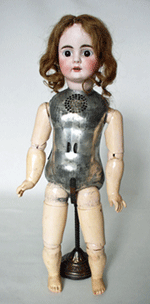
Toy phonograph patent granted (March 11, 1890)
A US patent (US423039) known as "Phonograph for Dolls or other Toys" was published on March 11, 1890, clearly positioning the invention as a toy.

Negotiations for capital allocation for the automatic (coin-operated) business (telegram from March 1890)
Telegrams from Alfred O. Tate (years of birth and death unknown) and others provide specific details about the allocation of capital and the division of labor among the parties involved in the coin-operated slot machine business.

The issue of "Who controls the cabinet?" (March 1890 letter)
In a letter from March 1890, the issue of which camp should be entrusted with the production of the cabinets was clearly stated as a point of contention, indicating that the "finished product as entertainment equipment" was more important than the recording itself.

Recorded in Passamaquoddy (March 15-18, 1890)
Jesse Walter Fewkes (1850–1930) recorded the songs of the Passamaquoddy and other animals on cylinders in Calais, Maine, from March 15 to 18, 1890, and these recordings are considered some of the earliest known field recordings.

Self-announcement within the recording (March 18, 1890, Calais, Maine)
The transcript shows Fuchs himself verbally stating the location and date as "Calais, Maine" and "March 18th, 1890," providing clues that increase the accuracy of the recording date.
Organizing "Passamaquoddy cylinders" as an archive (collection and explanation)
The Library of Congress has organized the Passamaquoddy Cylinder Recordings into a collection and provides explanatory pages that provide references to both recording history and folklore history.

Phonograph touring demonstrations in the United States (example of an article introducing the device around March 1890)
Local articles also describe how Edison Phonograph demonstrations were held in various places, reinforcing the fact that recording and playback was a widespread event for audiences.

Performances at opera houses etc. (Example of newspaper article dated March 15, 1890)
An example from the March 15, 1890, edition of the newspaper advertises a demonstration of the "Edison Phonograph" at the Opera House, revealing that a performance was being held that allowed audiences to experience "recorded sound."